From Web Developer to Game Developer: A Non-Linear Path Through Open Source
Loom Lounge Episode 3. How a generalist mindset, an open source career path, and a leap of faith built some of Threadbare's most iconic mechanics
Most career advice tells you to pick a lane. Specialize. Become the best at one thing. But some of the most interesting careers in tech don't work that way at all. They wind through unrelated communities, pick up skills along the way, and end up somewhere nobody could have predicted from the starting point.
This is one of those careers. And it's also a story about how Threadbare gets made.
In Episode 3 of Loom Lounge, Heather and Stephen sat down with one of Threadbare's developers and maintainers, Manuel, a software engineer based in Argentina, to talk about a path that didn't follow a straight line, and a game that wouldn't exist in the same way without him.
If you missed the last conversation, Episode 2 covered how the team built Threadbare in 8 weeks with a group that had never made a game before. This episode picks up where that one left off, zooming in on one of the developers who's helped shape what Threadbare has become.
The career that didn't go as planned
Manuel didn't grow up planning to make games. He grew up playing them. Monkey Island, Prince of Persia, Doom on a Pentium PC, hours of point-and-click adventures on floppy disks in 1990s Argentina. But the path from there to "professional game developer" wasn't obvious, and it certainly wasn't linear.
"I always imagined myself connecting my two worlds, the technical side and the more artistic side, but not specifically a game developer. I kind of stumbled into it. I started programming because of video games. So it's a full circle moment."
That full-circle moment took years to arrive. Along the way, Manuel built desktop apps, worked on educational software, and did web development. Game development wasn't the destination he was aiming at. It was the place he eventually ended up.
The case for being a generalist
One of the most striking things about this journey is how openly Manuel talks about not being a specialist. In a world that constantly tells us to pick a lane, he made a different choice.
"It took me a while to understand that I am not a specialist. I'm basically not the best at anything. I think it's great that we have specialists. Doctors who can do open heart surgery, kernel hackers, game engine developers who can speak to the GPU. But being a generalist is also a possible path. I just want to know a little bit of each field, enough to do the job in a more pragmatic way."
That pragmatism is exactly what makes Manuel so valuable on a multidisciplinary project like Threadbare. He can draw. He can animate. He can write production code. He can review pull requests from learners. He can prototype a brand-new mechanic on a whim. None of those things in isolation would be enough, but together, they're a superpower.
As Heather put it during the episode, careers counselors rarely talk about generalism. Schools sort students into buckets based on their grades and tell them to specialize. But the ability to move fluently between disciplines, to translate between art and code, between learner and developer, turns out to be one of the most useful skills you can have when building something genuinely new.
From open source to Endless
The path into game development started in a place that should sound familiar to anyone who's followed Threadbare's story: open source.
While studying at university, Manuel discovered the local Linux community in Argentina. That led to the Python community. Which led to Sugar, an educational project from One Laptop Per Child. Which led to the GNOME desktop community. Which eventually led to Endless.
"It was one opportunity after the other, but it wasn't linear at all. Now Endless makes games, which I wasn't expecting. It's like closing the circle."
This is what happens when you say yes to communities. You don't always know where they'll take you, but they keep opening doors.
The culture shock of game code
Moving from desktop apps and web development into game development wasn't just a job change. It was a culture change.
"Games are software projects, but they're very unique software projects because of the creative side. The code base tends to be much messier. I had to learn how to go faster in making prototypes, in putting myself in that mood. This is true even in big successful commercial games."
When Endless partnered with Funny Pack, the studio behind Runa on Steam, to build the original Threadbare MVP, the cultural differences between open source software engineering and commercial game development became visible quickly. Both sides learned from each other.
The lesson? Game code lives by different rules. It's faster, scrappier, more iterative. Polish comes later. Getting something playable comes first.
Building tools for learners (not just for developers)
A huge part of the work on Threadbare isn't writing the game itself. It's building the on-ramps that let other people contribute to it.
That's where the Godot editor comes in. Godot is the free, open-source game engine that powers Threadbare, and Manuel walked viewers through some of the scaffolding the team has built on top of it:
- Story Quest templates, pre-built combat, stealth, and puzzle scenes that learners can duplicate and modify to start their own stories
- Playgrounds, open sandboxes with no goals, just toys: levers to repel, balls to throw, pillars to grapple
- The Inspector panel, a visual interface where learners can tweak game properties (like a lever's targets or a grappling hook's max length) without writing a single line of code
"We want to make a fun game, a game that's super fun, good-looking, that players enjoy. And we also have the educational side. We want this to be a door, to lower the barrier for learners to make their own stories, their own games, become game developers themselves. There's a tension between those two goals. What we expose to learners is the tricky part."
That tension between making a great game and making a great learning tool sits at the center of every design decision on Threadbare.
The grappling hook: a feature that started with an idea
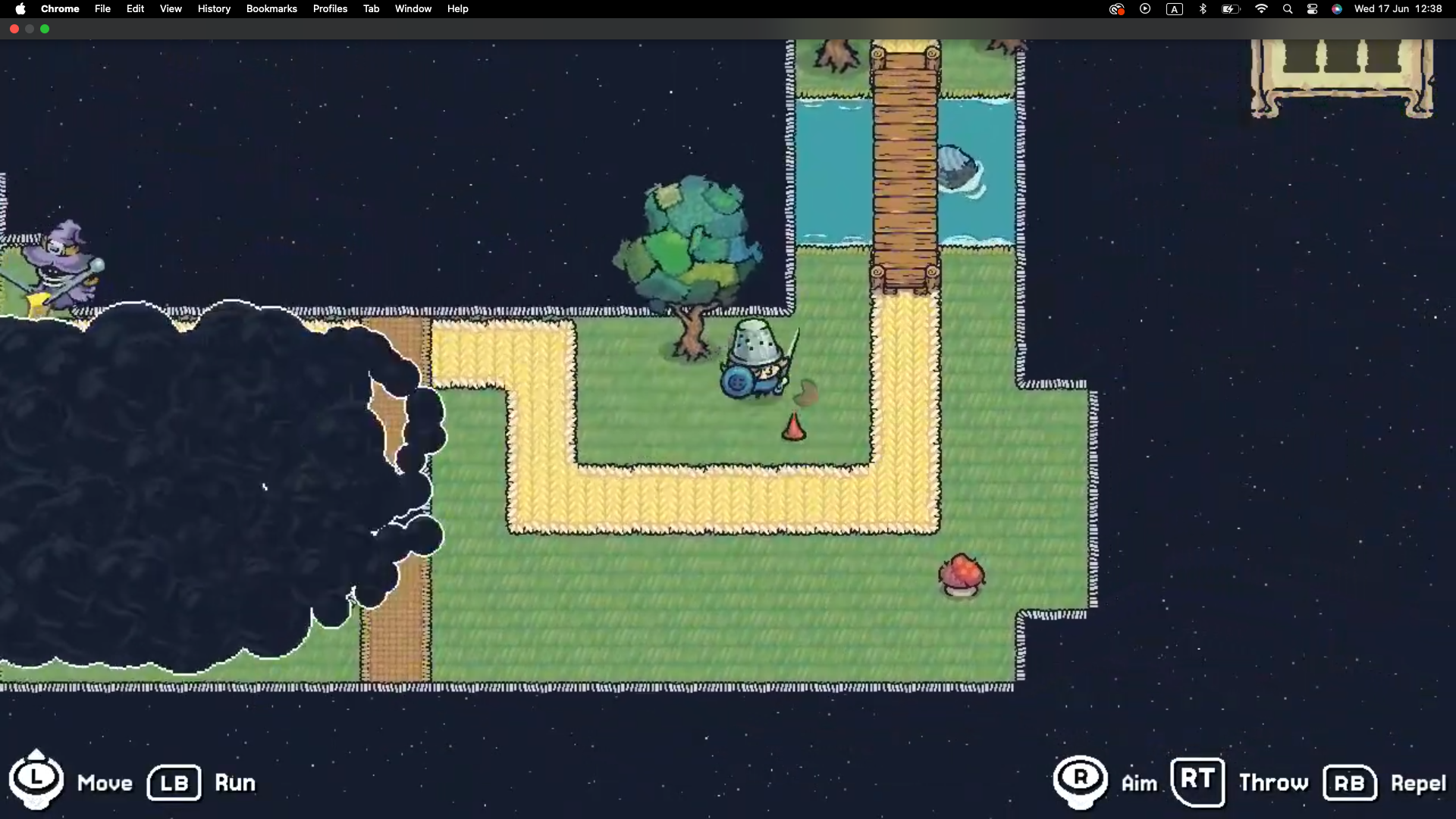
If you've played Threadbare recently, you've probably used the grappling hook. It's now one of the core mechanics for navigating the world, escaping the void, and solving puzzles.
It exists because one of the developers had an idea and asked if he could build it.
"Manuel came to us and said, 'I have this idea for a grappling hook.' And we just said, 'Go for it.' That's the beauty of Threadbare. It's not dictated by a linear roadmap. It's generated by the ideas people bring to the table, not just our own developers, but anyone in the world who fancies the opportunity." — Stephen
Since then, the grappling hook has been extended, refined, and combined with other abilities, including the repel mechanic, which used to only work in combat and now works on levers, pillars, and environmental puzzles.

When the community surprises you
Here's the moment that made the whole episode click.
While the team was iterating on a pull request for the new "abilities" system, which finally let players combine grapple and repel at the same time, a learner from Peru, Alvaro Roldán, was watching the work in progress on GitHub. Before the feature was even merged, Alvaro built his own test level that combined the two abilities into a single puzzle: deflecting ink while grappling to safe zones.
"It was great because the abilities weren't even merged yet. You could only have one at a time. But they were following our development and came up with this idea of combining them."
That's the model in action. Open development. Public pull requests. A learner halfway across the world contributing a level that the core team hadn't even imagined yet.
Bugs, frustrations, and "Figure It Out Fridays"
The episode was honest about the things that still keep developers up at night. One of them: how to handle elevations in a 2D top-down game without making the codebase ten times more complex.
"Many games have fake elevations because that simplifies a lot. If you really want real elevations, each component has to know exactly when you're entering a third dimension. I'm still wondering how we can have this without adding too much complexity."
Rather than hide that struggle, the team is leaning into it. Stephen floated the idea of "Figure It Out Fridays", live streams where developers tackle these unsolved problems in public, with viewers contributing ideas (and even code) in real time.
This is what open source game development looks like when you take the "open" part seriously: the bugs are public, the design questions are public, and the solutions can come from anywhere.
A note on language
One of the most quietly powerful moments in the episode was a reflection on working in code as a non-native English speaker.
"Nowadays it's a bit different because, thanks to AI, it's super easy to work together. GitHub automatically translates comments. Learners type in Spanish and we get it in English. Of course, I still recommend learning English if you want to do game development. It opens so many doors. But the technical part is not that much."
For the global community building Threadbare, that's a real thing. Contributors don't all share a language, but they share a project. And the tools for collaborating across that gap keep getting better.
The takeaway
This career didn't follow a roadmap. Threadbare doesn't either. And neither, frankly, do most of the careers and projects that turn out to matter.
What this story reminds us is that being a generalist isn't a backup plan. It's a strategy. That open source isn't just a licensing model. It's a career path. And that some of the best contributions to a game come from people who weren't in the original plan at all.
"I don't consider myself an artist, but someone who can draw, can animate. Games are multidisciplinary. That's why making games as a community is great. Everyone, from different skills, can give their input."