A Bridge Across Two Worlds: How ÁNIMA and Endless Access Are Reimagining Game-Based Learning in Uruguay
When Facundo walked into ÁNIMA for the first time, he was fifteen years old, deeply curious about computers, and unmistakably shy. He had taught himself how to build a basic web page from a YouTube tutorial when he was younger, and he loved the logic of it. He had even tried, once, to build a video game. But he abandoned the attempt. The art was beyond him, the music was beyond him, the narrative was beyond him. "I felt I lacked the creative side," he says now. He decided games were not his world.
Six years later, Facundo is twenty-one, and he is the instructor leading a pilot at ÁNIMA that teaches teenagers to build video games. The students he teaches today are younger than the version of himself who first walked through the door.
This is not a coincidence. This is the system working.
The problem ÁNIMA exists to solve
In Uruguay, only two out of every ten young people from low-income backgrounds finish high school. Youth unemployment is triple the general unemployment rate. Roughly eighty percent of jobs are found through personal networks, which means a society shaped by territorial and social segregation also reproduces that segregation economically. The young people most in need of opportunity are the most cut off from the networks that would deliver it.
These numbers are specific to Uruguay, but the pattern is not. Across Latin America and much of the world, the same structural gap exists: an education system that does not connect to the labor market, a labor market that hires through trust networks that exclude the people who most need access, and a generation of young people caught in the middle. Any organization working on youth opportunity in Mexico, Brazil, Colombia, Kenya, or Jordan will recognize the shape of this problem.
ÁNIMA was founded in 2015 by five people who could see both worlds. Some of them had spent years working with underserved youth through social organizations. Others had worked in the corporate world. They recognized something most institutions miss: each world had something the other needed, and neither could build the bridge alone.
.png)
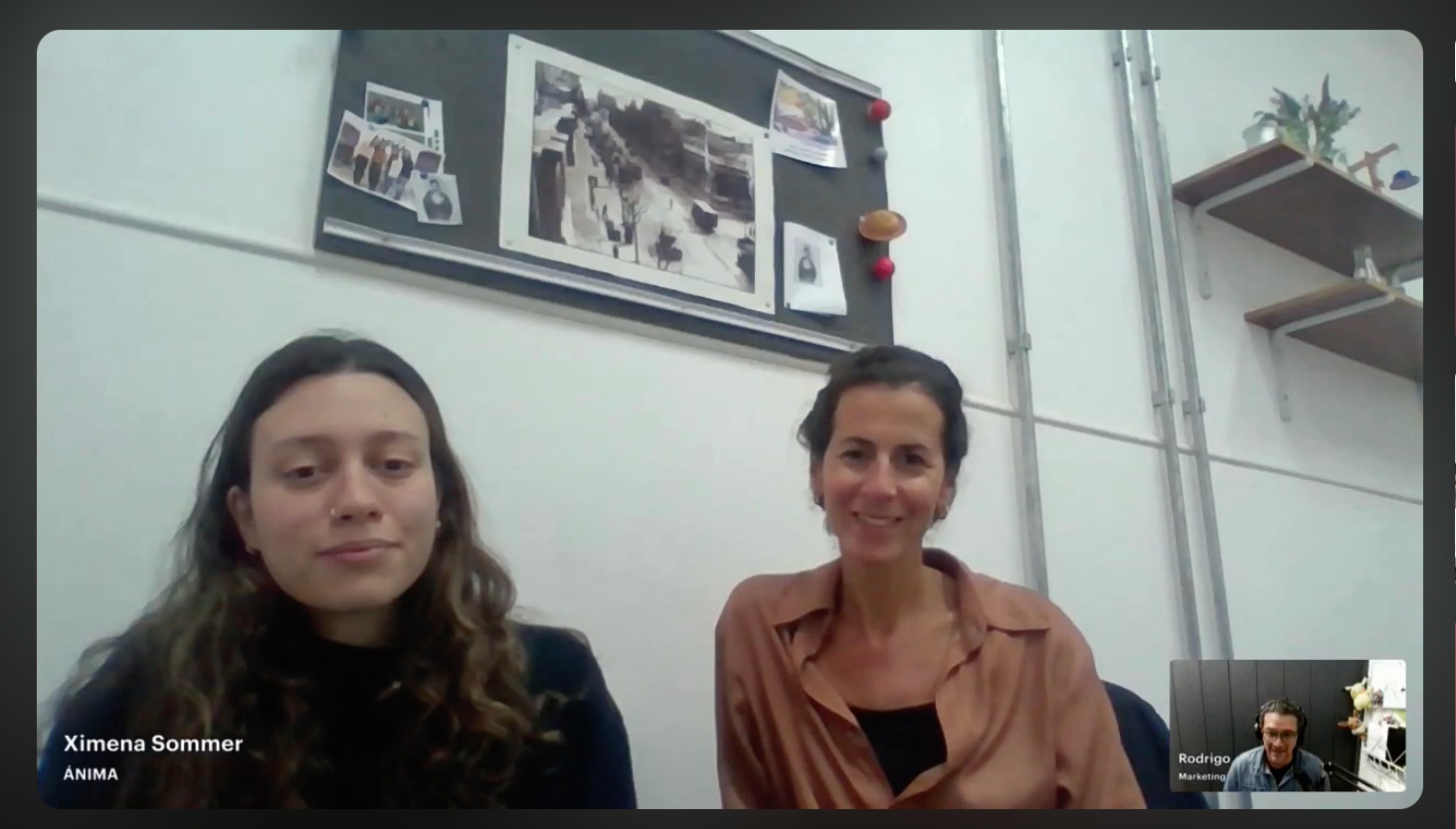
"In Uruguay, almost eighty percent of people find work through personal networks," explains Ximena Somer, ÁNIMA's Executive Director and one of its co-founders. "When you have a social fabric with significant territorial and social segregation, you need bridges that extend the social capital of people who are most segregated."
This is the problem ÁNIMA was built to solve. Not through advocacy. Not through a single program. Through a redesign of how education itself works.
The dual education model
ÁNIMA's pedagogical foundation is the German dual education model, adapted for Uruguay. The premise is simple and quietly radical: work is itself a learning environment. Students should not be trained in classrooms for years and then handed over to the labor market. They should move between the two from the start.
At ÁNIMA, students alternate between classroom learning and paid practical placements at real companies, in two tracks: technology and business administration. The curriculum is not designed by the school in isolation. It is designed in partnership with the productive sector. Companies help define what competencies a graduate should have. ÁNIMA then builds the program backwards from there, using project-based learning, applied work, and a teaching philosophy that treats teachers as guides rather than as gatekeepers of knowledge.
"Work is a space of learning," Ximena says. "Why isn't this structured inside the education system? Why can't educational institutions be bridges?"
The result is a model that does not look like a typical NGO program. ÁNIMA is a registered educational institution operating within Uruguay's formal education system, but its structure, culture, and pedagogy are built around collaboration with companies and continuous adaptation. The students who graduate are not just credentialed. They are already inside the networks that would have otherwise excluded them.
Ten years in, the model has been refined through experience. The graduate community is large enough that some graduates are now coming back as instructors, contributors, and mentors— including Facundo.
How the partnership began
ÁNIMA looks for partners who can expand and diversify how its learners learn. The organization's identity is collaborative by design, and does not want to be the sole author of any single learner's experience. It meant to be part of an ecosystem.
When Endless Access entered the picture, the alignment was immediate. Endless Access is a global nonprofit working to expand access to digital skills and the digital economy through game development, with the conviction that game-making teaches the multidisciplinary capabilities that the modern software economy requires. Their model relies on partnerships with local organizations who deliver the learning experience on the ground.
For ÁNIMA, that conviction landed in familiar terrain.
"Finding a partner whose purpose is to develop digital skills through game creation is exactly something ÁNIMA wants to offer, wants to expand in Uruguay," Ximena says. "We dream of being the Endless hub in Uruguay."
What made the partnership possible was not paperwork, but recognition. Two organizations, built in different parts of the world for different reasons, both convinced that the gap between education and the future of work has to be closed deliberately, and that young people from underserved contexts deserve serious, applied tools to close it.
Running the pilot
Strategic alignment is one thing. Running a pilot is another.
Leticia, who coordinates ÁNIMA's Employability Program, plays a central role in how partnerships translate into actual student experience. Her job is to connect ÁNIMA's learners with the companies and programs that will shape them, including the new Endless Access pilot. That meant identifying which student groups would participate, briefing instructors, integrating new material into the program structure, and creating the feedback loops that would let ÁNIMA learn alongside the students.
For Facundo, the brief landed differently than other materials he had been asked to teach. He had never taught game development before. He had taken a short Godot course on his own, but he knew he was missing the structure to teach it. When Endless Access offered training, he saw an opportunity to grow as an instructor at the same time he taught students to grow as creators.
"I loved it the moment they told me," Facundo says. "I started reading everything I could about it."
Training came from the Endless Access team, with Andrea leading the instructor onboarding. As Facundo went through the materials, he noticed something unusual. Most external curricula do not align cleanly with ÁNIMA's pedagogical pillars. This one did. The emphasis on applied learning, on collaboration, on giving students room to make creative decisions and own the outcome, all of it matched what he was already trying to do in his programming classes.
Leticia noticed something different, but related.
"Having experts in service of the process was something we hadn't experienced with other subjects or other partners," she says. The Endless Access team did not hand over materials and walk away. They participated. They listened. They adjusted. For a partnership organization that has worked with many others over a decade, that distinction stood out.
What happened in the classroom
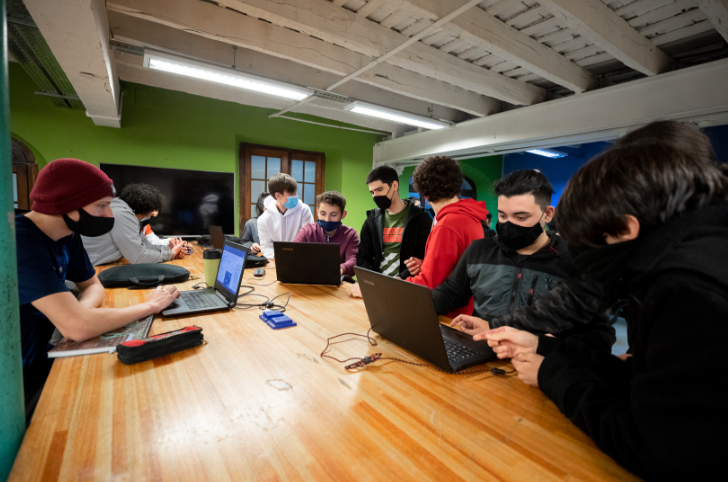
The pilot ran across both ÁNIMA's bachillerato (high school) and finest (adult) programs. Students were given the unusual freedom of choosing their own teams based on the roles they wanted to play within them: programming, art, narrative, design. At ÁNIMA, teams are usually assigned by teachers. Letting students self-organize was a deliberate departure that mirrored how real game development teams form.
What surprised Facundo most was who got hooked.
"What caught my attention was that everyone became engaged, regardless of whether they liked games or not," he says. The pilot included students who had no particular interest in video games when they walked in. By the end, all of them had finished a game.
Several things happened at once. Students discovered the multidisciplinary nature of game development, which collapsed boundaries between subjects they had treated as separate. Programming connected to design. Writing connected to narrative mechanics. Visual art connected to user experience. Music connected to mood. The students did not need to be told that creative work draws on everything. The project taught them.
"Finding all of that in a single workshop was both interesting and challenging for them," Leticia says.
Collaboration happened more naturally than ÁNIMA usually sees in its programs. Teamwork is hard to cultivate in any educational setting, and harder in Uruguay where individualism is part of the cultural texture. But because the students wanted to build something together, the team dynamics emerged on their own. Students brought ideas to Facundo unprompted. "Profe, I found this thing in another game, how do we add it?" became a recurring moment. They were searching, experimenting, hitting walls, and pushing through.
Not everything worked,some teams ran out of time. The program's structure, which asks students to build several minigames in sequence, sometimes felt demotivating to students who had only finished one and faced two more before they could call themselves done. Facundo, who has now lived inside the curriculum from both sides, has thoughts about how the next iteration could be tightened: combining the minigames into a single richer project, allocating more time, building motivation differently.
This is what a partnership in service of the process looks like. The instructor gets to say what worked, what did not, and what should change. The organization listens.
The AI moment, and why it reinforces this approach
Halfway through her conversation with Endless Access, Ximena raised something unprompted: artificial intelligence.
It is impossible to talk about education today without confronting AI. For ÁNIMA, an institution whose entire model depends on the relationship between learning and the labor market, AI is not an abstract topic. It is a rupture in both worlds simultaneously. The skills the labor market values are shifting under everyone's feet. The pedagogical tools available to teachers are multiplying faster than anyone can evaluate them. The students walking into classrooms today will graduate into a labor market no one has fully imagined yet.
Ximena draws an unexpected parallel.
"I associate what I am experiencing now with what I lived during the pandemic," she says. "Each person lived the pandemic differently, of course, but there is a resonance."
What she means is that AI, like COVID, is not a tool you adopt. It is a paradigm shift you have to absorb. It changes what humans are for. It changes what creative work looks like. It changes what skills employers value. And it requires institutions to slow down, learn, reflect, and integrate, rather than rush to a quick output.
ÁNIMA is doing several things at once. They are giving themselves space as an organization to talk about what AI brings up, including the fears and the limiting beliefs that come with it. They are encouraging students to actually use the tools, including having students design their own AI agents for their integrating projects. They are working with a partner laboratory focused on AI innovation. And they are deliberately positioning themselves as learners, not experts.
"We are declaring ourselves apprentices," Ximena says. "Conscious that we want to be part of this, and that to do that, we need to give ourselves time and space to learn."
This posture is the same posture the dual model has always asked for. Applied learning. Comfort with uncertainty. A willingness to learn from real situations rather than wait for the perfect curriculum. The AI moment is not a departure from ÁNIMA's approach. It is a vindication of it.
It is also the kind of moment that exposes what makes a partnership sustainable. When the ground is shifting this fast, the partnerships that survive are the ones built on shared values and shared posture, not on locked-in deliverables.
What ÁNIMA values about working with Endless Access
If you ask Ximena what makes Endless Access different from other partners, she does not list features. She does not talk about budgets or deliverables. She talks about posture.
"What we value most about you is the value you place on the process, not just the outcome," she says. "That is not easy in today's times."
In a sector increasingly oriented around short-term metrics and quarterly impact reporting, this is genuinely unusual. Most education partnerships are structured around output measures: how many students completed the program, how many landed jobs, how many credentials were issued. Those numbers matter. But they often crowd out the learning that has to happen for an institution to actually get better.
Endless Access has consistently valued the feedback ÁNIMA provides, including from students directly. It has treated the pilot as a real pilot, with room to refine, redesign, and rethink. Leticia, who has seen many partner relationships from the inside, describes this kind of attention as the exception, not the rule.
For ÁNIMA, this is what makes the relationship sustainable. Not just funded.
What's next
ÁNIMA is celebrating ten years. The dual model that began as a quiet experiment in 2016 has reached its second decade as a working institution with a graduate community, a track record, and a network of partner companies and organizations. The pilot with Endless Access has opened a new layer of what ÁNIMA can offer to students, both in tech and in adjacent skills that emerge from making something together.
Ximena's vision for what comes next is direct: a fully realized Endless hub in Uruguay. A place where the partnership is not a pilot but a permanent layer of how ÁNIMA teaches and how Endless Access reaches Latin America.
The model is replicable. The structural problem ÁNIMA solves in Uruguay exists, in different shapes, across Latin America, the MENA region, sub-Saharan Africa, South Asia, and much of the world. The dual model is not the only answer.However, a partnership built between an institution with deep local context and an organization with real tools and a serious mission is a pattern other organizations can learn from.
For potential partners reading this, the invitation is straightforward. Endless Access is looking for institutions doing serious work in their own contexts. ÁNIMA is proof that the partnership can be deep, durable, and transformational.
Closing
Facundo is twenty-one years old. He graduated from ÁNIMA at seventeen. He has been teaching for two years and leading the Endless Access pilot for one. His students are now the age he was when he walked through the door.
When he was their age, he was too shy to ask to join a game development group. He gave up on his first attempt to make a game. Today, he teaches the students whose shyness he recognizes from his own youth, and he uses the tools he once thought were not for him to do it.
"I felt I had the tools to help these students move past their shyness before it became a real barrier," he says.
This is what the partnership is really for. Not the program, not the curriculum, not the pilot reports. Facundo. And every student sitting in his classroom right now, learning how to make something they did not believe they could make.
Endless Access is a nonprofit working to empower the next generation of digital creators through a global game-making community and the tools that spark creativity, build collaboration, and develop future-ready skills. The work is done alongside learners, educators, and partners who share the conviction that underserved creators deserve serious tools and serious mentorship to build their own games, their own communities, and their own futures. ÁNIMA is one of those partners. Facundo is one of those creators. And the door is open for others to join.